Practice Problems 9

Lecture 9: Continuity and Rules of Differentiation

Problem numbers refer to the textbook (Chiang & Wainwright, 4th edition). These are not graded, but you should attempt them all before the quiz. Try each question yourself first, then expand the Solution to check.

Exercise 7.1

3. Find f′(1) and f′(2) for the following functions:

  1. y=f(x)=18x
Solution

f′(x)=18

f′(1)=18f′(2)=18

  1. y=f(x)=cx3
Solution

f′(x)=3cx2

f′(1)=3cf′(2)=12c

  1. f(x)=−5x−2
Solution

f′(x)=10x−3

f′(1)=10f′(2)=108=54

  1. f(x)=34x4/3
Solution

f′(x)=x1/3=x3

f′(1)=1f′(2)=23

  1. f(w)=6w1/3
Solution

f′(w)=2w−2/3

f′(1)=2f′(2)=2⋅2−2/3=21/3

  1. f(w)=−3w−1/6
Solution

f′(w)=12w−7/6

f′(1)=12f′(2)=12⋅2−7/6=2−13/6

Exercise 7.2

3. Differentiate the following by using the product rule:

  1. (ax−b)(cx2)
Solution

Let f(x)=ax−b and g(x)=cx2, so f′(x)=a and g′(x)=2cx.

ddx[f(x)g(x)]=f′(x)g(x)+f(x)g′(x)=acx2+(ax−b)2cx=acx2+2acx2−2bcx=3acx2−2bcx

  1. (2−3x)(1+x)(x+2)
Solution

Let f(x)=(2−3x)(1+x) and g(x)=x+2, so g′(x)=1. Using the product rule on f(x) itself:

f′(x)=−3(1+x)+(2−3x)(1)=−(6x+1)

Then

ddx[f(x)g(x)]=f′(x)g(x)+f(x)g′(x)=−(6x+1)(x+2)+(2−3x)(1+x)=−6x2−13x−2+2−x−3x2=−9x2−14x=−x(9x+14)

7. Find the derivatives of:

  1. (x2+3)/x
Solution

With f(x)=x2+3, f′(x)=2x, and g(x)=x, g′(x)=1:

ddxf(x)g(x)=f′(x)g(x)−f(x)g′(x)g(x)2=(2x)x−(x2+3)⋅1x2=x2−3x2

  1. (x+9)/x
Solution

ddxx+9x=1⋅x−1⋅(x+9)x2=−9x2

  1. 6x/(x+5)
Solution

ddx6xx+5=6(x+5)−1⋅6x(x+5)2=30(x+5)2

  1. (ax2+b)/(cx+d)
Solution

ddxax2+bcx+d=2ax(cx+d)−(ax2+b)c(cx+d)2=2acx2+2adx−acx2−bc(cx+d)2=acx2+2adx−bc(cx+d)2

8. Given the function f(x)=ax+b, find the derivatives of:

  1. f(x)
Solution

f′(x)=a

  1. xf(x)
Solution

ddx(ax2+bx)=2ax+b

  1. 1/f(x)
Solution

ddx1ax+b=0⋅(ax+b)−a⋅1(ax+b)2=−a(ax+b)2

  1. f(x)/x
Solution

ddxax+bx=ax−(ax+b)⋅1x2=−bx2

Exercise 7.3

1. Given y=u3+2u, where u=5−x2, find dy/dx by the chain rule.

Solution

dydu=3u2+2dudx=−2x

dydx=dydu⋅dudx=(3u2+2)(−2x)=−2x[3(5−x2)2+2]

2. Given w=ay2 and y=bx2+cx, find dw/dx by the chain rule.

Solution

dwdx=dwdy⋅dydx=2ay(2bx+c)=2a(bx2+cx)(2bx+c)

3. Use the chain rule to find dy/dx for the following:

  1. y=(3x2−13)3
Solution

Let z=3x2−13, so y=z3:

dydx=dydz⋅dzdx=3z2(6x)=18x(3x2−13)2

  1. y=(7x3−5)9
Solution

Let z=7x3−5, so y=z9:

dydx=dydz⋅dzdx=9z8(21x2)=189x2(7x3−5)8

  1. y=(ax+b)5
Solution

Let z=ax+b, so y=z5:

dydx=dydz⋅dzdx=5z4(a)=5a(ax+b)4

4. Given y=(16x+3)−2, use the chain rule to find dy/dx. Then rewrite the function as y=1/(16x+3)2 and find dy/dx by the quotient rule. Are the answers identical?

Solution

Chain rule, with z=16x+3 and y=z−2:

dydx=dydz⋅dzdx=−2z−3(16)=−32(16x+3)3

Quotient rule, where the derivative of the denominator is 2(16x+3)⋅16=32(16x+3):

dydx=0⋅(16x+3)2−1⋅32(16x+3)(16x+3)4=−32(16x+3)3

The answers are identical.

5. Given y=7x+21, find its inverse function. Then find dy/dx and dx/dy, and verify the inverse-function rule. Also verify that the graphs of the two functions bear a mirror-image relationship to each other.

Solution

The inverse function is x=y−217.

dydx=7dxdy=17=1dy/dx

so the inverse-function rule holds. To graph the inverse with its own independent variable on the horizontal axis, write it as y=(x−21)/7. The two lines are mirror images of each other across the 45-degree line y=x:
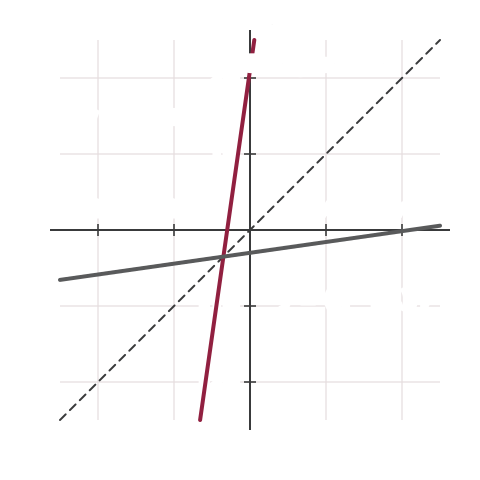
Three lines on the same axes, each running from negative 25 to 25: the steep line y equals 7x plus 21, the flat line y equals x minus 21 over 7, and a dashed 45-degree line y equals x between them; the two solid lines are reflections of each other across the dashed line

6. Are the following functions strictly monotonic? For each strictly monotonic function, find dx/dy by the inverse-function rule.

  1. y=−x6+5(x>0)
Solution

dydx=−6x5<0 for x>0

So the function is strictly decreasing, hence strictly monotonic, and

dxdy=1dy/dx=−16x5

  1. y=4x5+x3+3x
Solution

dydx=20x4+3x2+3>0 for all x

So the function is strictly increasing, hence strictly monotonic, and

dxdy=120x4+3x2+3