ECON 201: Principles of Microeconomics
Lecture 10
Today: when something is bought and sold, how much does everyone gain from the sale?
Who gains from these sales, and by how much?
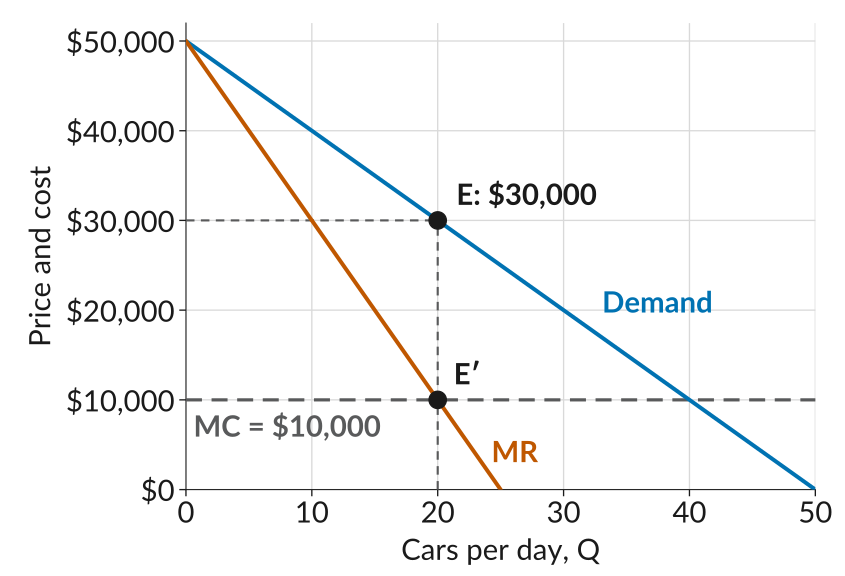
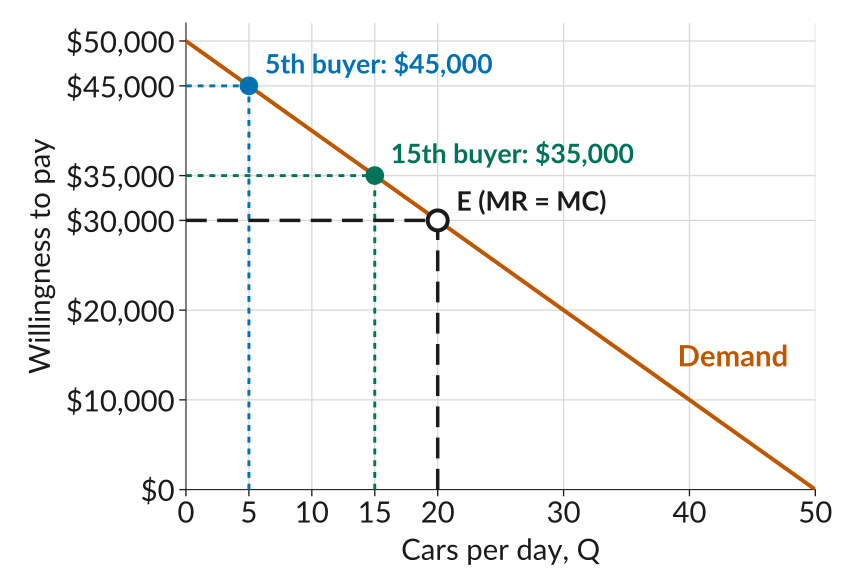
The 5th buyer’s willingness to pay for a car is $45,000. What is the buyer’s gain from the sale?
\[\text{Buyer's gain} = \text{WTP} - P = 45{,}000 - 30{,}000 = 15{,}000\]
What is the firm’s gain from the sale? It is the profit on this one car:
\[\text{Firm's gain} = P - \text{MC} = 30{,}000 - 10{,}000 = 20{,}000\]
The joint surplus (a measure of the gains from trade) is the sum of the economic rents of all involved in an economic interaction:
\[\text{Joint surplus} = \underbrace{(\text{WTP} - P)}_{\text{buyer's gain}} + \underbrace{(P - \text{MC})}_{\text{firm's gain}} = \text{WTP} - \text{MC} = 35{,}000\]
Doing the same for the 15th buyer, whose willingness to pay is $35,000:
| Buyer | WTP | Joint surplus, \(\text{WTP} - \text{MC}\) | Buyer’s gain, \(\text{WTP} - P\) | Firm’s gain, \(P - \text{MC}\) |
|---|---|---|---|---|
| 5th | 45,000 | 35,000 | 15,000 | 20,000 |
| 15th | 35,000 | 25,000 | 5,000 | 20,000 |
What is the total gain in the market, adding up the gains of all the buyers and the firm’s gains on all the cars it sells?
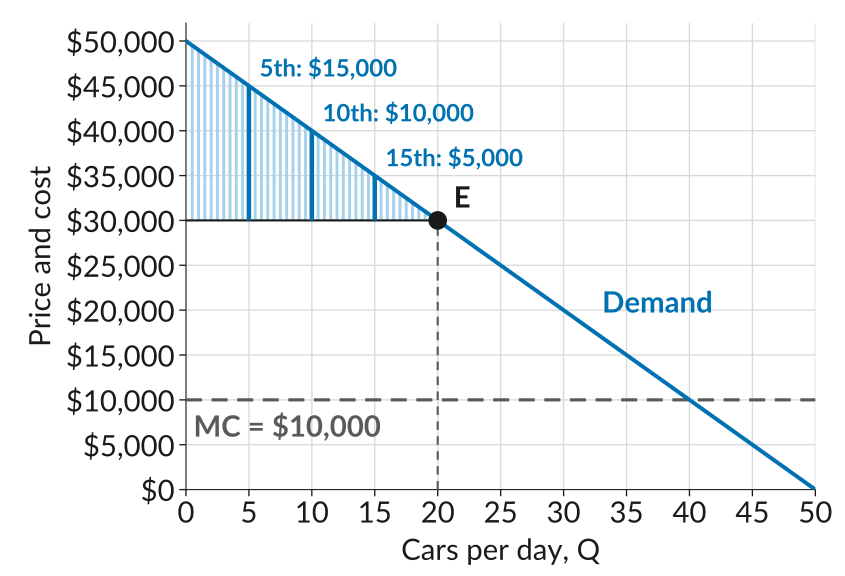
Each consumer’s surplus from a sale is \(\text{WTP} - P\).
Consumer surplus (CS): the sum of these surpluses across all consumers.
Calculate using the area of a triangle:
\[\begin{aligned} \text{CS} &= \tfrac{1}{2} \times \text{base} \times \text{height} \\ &= \tfrac{1}{2} \times 20 \times 20{,}000 \\ &= 200{,}000 \end{aligned}\]
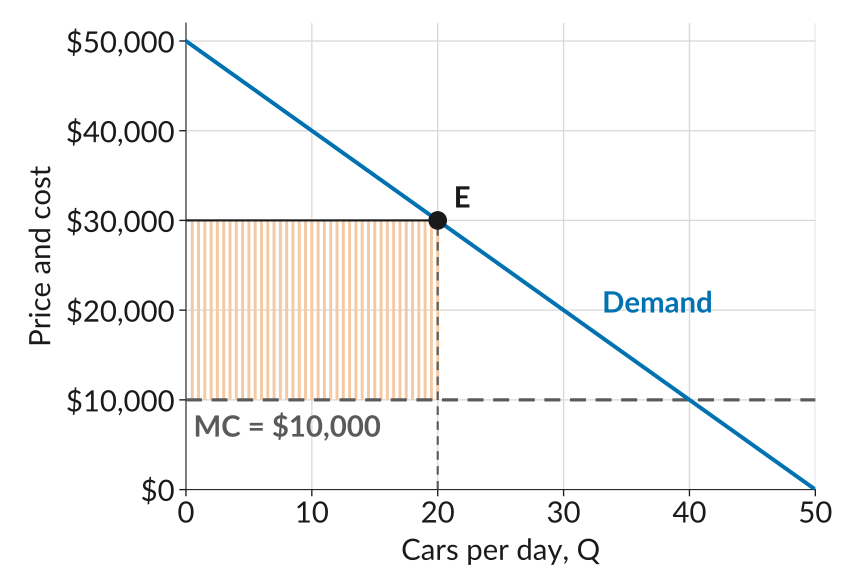
The firm’s surplus from each sale is \(P - \text{MC}\).
Producer surplus (PS): the sum of these surpluses across all units sold.
Calculate using the area of a rectangle:
\[\begin{aligned} \text{PS} &= \text{base} \times \text{height} \\ &= 20 \times 20{,}000 \\ &= 400{,}000 \end{aligned}\]
Producer surplus is not the same as profit. The difference is the fixed cost.
Recall that Beautiful Cars’ cost function is \(C(Q) = 60{,}000 + 10{,}000Q\), with a fixed cost of $60,000 a day. Its profit from 20 cars at $30,000 is
\[\text{Profit} = \underbrace{30{,}000 \times 20}_{\textstyle\style{font-size:90%}{\text{Revenue}}} - \underbrace{(60{,}000 + 10{,}000 \times 20)}_{\textstyle\style{font-size:90%}{\text{Cost}}} = 340{,}000\]
The producer surplus was $400,000, so
\[\text{Profit} = \text{Producer surplus} - \text{Fixed cost} = 400{,}000 - 60{,}000 = 340{,}000\]
Producer surplus compares selling cars with selling none. Even if Beautiful Cars sold no cars today, it would still pay $60,000 for its factory, so that cost is not part of what its sales add.
The joint surplus from a sale does not depend on the price:
\[\text{Joint surplus} = \text{WTP} - \text{MC}\]
ECON 201 · Lecture 10